Ramit Sethi’s I Will Teach You To Be Rich is a book that seems to be everywhere, but that’s likely because the author is everywhere. Sethi has appeared on news channels, talk shows, podcasts, reddit, even Netflix. So I decided to read the book that started it all, and tell you what I thought.
As Sethi himself puts it, the book, first published in 2009 and then updated in 2019, contains, “No get rich quick schemes, no shady tips and tricks, just tried and true methods to spend guilt-free while building real wealth.”
The book is geared towards younger investors, but I did find a lot of it useful for myself as well. It offers a 6-week program that helps the reader figure out where their money is currently going and helps them redirect it to where they want it to go. Here’s the outline for each of the six weeks:
- The first week focuses on setting up credit cards and making them work for you – and shows you how to make your credit score better.
- The second week helps you optimize your bank account, including tips on how to negotiate lower fees. This would be a good time to explain that Sethi is based in the U.S., so some of the guidance may work differently here in Canada. For example, I did try and call my local bank to negotiate my bank fees lower and can confirm it got me precisely nowhere. However, Canada does have many low-or-no fee bank accounts, so all you must do in this week is shift over instead.
- The third week focuses on opening and setting up registered retirement accounts (like Registered Retirement Savings Plans (RRSPs) and Tax-Free Savings Accounts (TFSAs) in Canada.). He recommends opening retirement accounts even if you have very little to invest in, you must start somewhere.
- Week four is all about a favourite topic here on MoneyFocus – Budgeting.
- Week five deals with all things automation. For example, automated investing seeks to build long-term wealth by consistently investing in low-cost index funds without the stress of picking stocks or timing the market. For example, the Harvest Travel & Leisure Index ETF (TSX: TRVL) is designed to track the performance of the Solactive Travel & Leisure Index GTR, which contains 30 dominant, large capitalization travel and leisure companies.
- Week six explains the ins and outs of investing, including the benefits of investing early. He reiterates that every year you wait to get started with investing, you miss out on potentially thousands of dollars
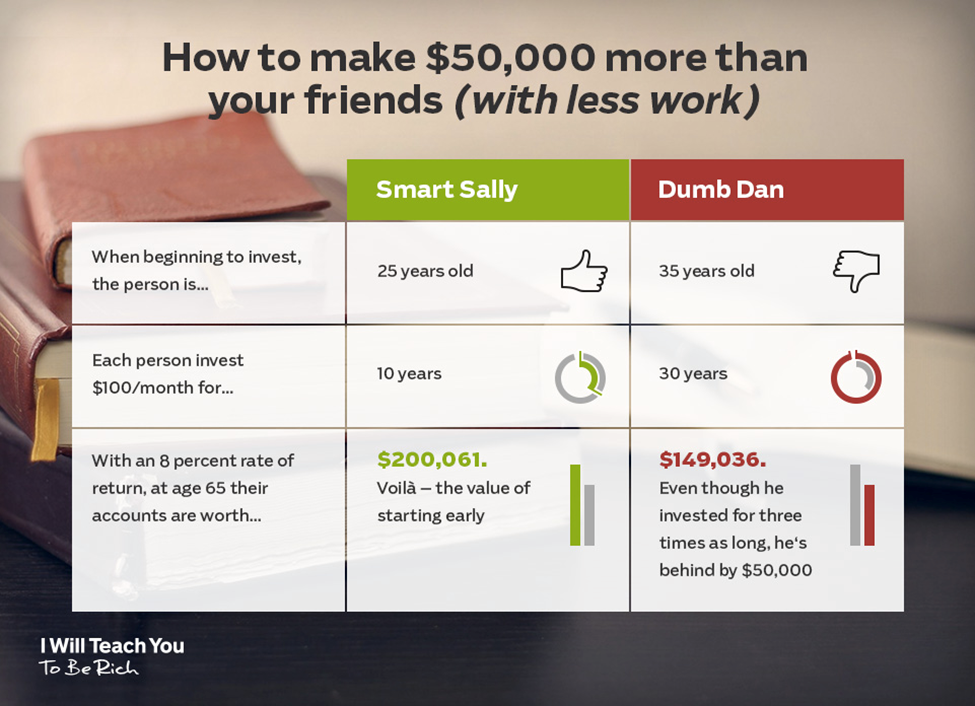
Source: Investing for Beginners: A Quick and Easy Guide to Investment. Ramit Sethi. https://www.iwillteachyoutoberich.com/investing-for-beginners/
The $50,000 investment and resulting growth are entirely hypothetical and shown for illustrative purposes only. This example does not represent actual performance, does not predict future results, and does not provide any guarantee of returns. All investing involves risk, including the potential for loss.
Important Tips, Strategies, and Philosophies
Apart from this 6-week strategy, the book is full of small and large actionable changes you could make to improve your overall financial health. Some of these are tactics, others are mottos, and one is a philosophy to life and money. Here are the ones that resonated most with me:
A Rich Life
Sethi places a large amount of emphasis on finding and living your “Rich Life.” Sethi spends a lot of time, both in a book, and in his other ventures, talking about this personalized philosophy. According to Sethi, a “Rich Life” is about more than money, it’s about the idea of abundance. He notes that a rich life is different for different people – for some it could be a luxury bag, for others it could be 3 foreign vacations a year, for still others it could be being at home when your kids get back from school. To Sethi, any financial goals, plans, or strategies should come only after you define your rich life.
He also specifically cautions against comparisons, because someone else’s rich life will definitely not be yours. For example, if your rich life is home by 3 p.m. to look after your kids, and your financial strategy involves building an account balance to fund 3 solo vacations hiking the Himalayas with your friends, chances are that strategy will leave you feeling stressed and unhappy. Chances are, that strategy will likely fail because it does not work for you and your rich life. If you want to find your rich life, Sethi has designed a quiz found here here.
Money Dials
Another idea I really enjoyed in Sethi’s book was the concept of “Money Dials.” Sethi believes that people may say what they think you want to hear, but they do what they really believe. Put another way, the places where people spend their money are what really matters to them. For example, people may say that they really love exercise and it’s their #1 passion, but if their spending sheets show no signs of a gym membership, exercise equipment, or athletic gear, or shoes, chances are they’re perhaps saying something and doing another. But if you see that they put their dollars to work, and spend every month on trips or tickets, chances are they are real, and travel is a priority for a rich life.
Sethi has narrowed down the thousands of expenses that people have into 10 core buckets, which he calls “Money Dials” because you can tune them up or down—just like a dial. No one dial is more important than the other in general – but one of them is most important to you. Here are the ten dials that Sethi has identified:
- Convenience
- Travel
- Health / fitness
- Experiences
- Freedom
- Relationships
- Generosity
- Luxury
- Social status
- Self-improvement
How do you know which is your #1? Sethi suggests that if you were magically given $10,000 today and you know immediately in which of these dials you’d spend it, you know your #1 dial. You can find examples here.
Automation and Systems
I think for me the biggest takeaway from “I Will Teach You To Be Rich” was the guidance and emphasis on automation. Sethi quotes Barry Schwartz’s The Paradox of Choice (which I also enjoyed and agree with) to explain that when faced with multiple choices, people freeze and do nothing. In short, analysis paralysis.
Sethi argues that if you leave your financial decisions to willpower, you will likely fail, and so, one of the surest paths to success is automation, and so, do your best to automate as much as you can. This could include setting up transfers out of your salary account into savings and investment accounts as soon as your paycheck hits. Or it could be automatic bill and payments. When it’s automatic, you don’t need to worry about willpower, because the decision is taken away from you. It’s done, and you didn’t have to do anything!
The Final Word
I enjoyed “I Will Teach You To Be Rich” by Ramit Sethi. It’s a good read, especially if you’re younger and/or newer to finance, but I also think that it offers new tactics and tips for even seasoned investors. It’s written in a conversational style, so it doesn’t feel dense and intimidating. I think it’s a good book!
Some Other Stuff I Tried Last Month:
- Les Incompetents, in St. Catherine’s ON. It’s defined as, “A place to enjoy a wonderfully French(ish) plate of food, sneak away for a cocktail (or deux), or gather with friends among friends.” I enjoyed it!
- Wuthering Heights, the 2026 movie adaptation of the 1847 novel which is, “A passionate and tumultuous love story set against the backdrop of the Yorkshire moors, exploring the intense and destructive relationship between Heathcliff and Catherine Earnshaw.” I loved the novel, as you know from my review, and quite liked the movie too!
- Orality – The Media Theory That Explains 99% of Everything, an episode of the Plain English Podcast hosted by Derek Thompson. In this episode, Thompson talks to Bloomberg’s Joe Weisenthal, where the two discuss an ongoing cultural shift from a literate culture to a strange post-literate world awash in social media and digital communications in which oral traditions are making a comeback. It made me think!
Disclaimer
The opinions and views expressed in this book are those of the author and do not necessarily reflect the views of Harvest ETFs. Similarly, the opinions and views expressed in this review are solely those of the reviewer (the Author) and do not represent the views of Harvest ETFs. The Author and Harvest ETFs have no affiliation with the author of the book.
This communication should not be considered as advice and/or a recommendation to purchase or sell the mentioned securities or used to engage in personal investment strategies. Tax, investment and all other decisions should be made with guidance from a qualified professional.