By Caroline Grimont
How I decide what I read is complicated. Sometimes, it’s because I like the cover, or sometimes it’s because the book is in a field I enjoy. Other times it’s because it was recommended to me by someone I know, still other times it’s because someone I follow in another way – podcasts, social media, TV shows – recommended it to their audience, and I chanced upon the recommendation and was intrigued. Often, it is a combination of two or three of these. Rarely, in fact, almost never, does a book come to me in all four settings.
“In This Economy?” was one of those books.
The cover was clear and simple – a tangled bit of red yarn on a blue backdrop, claiming to explain how money and markets work. That was appealing. Check one. I do like markets, and the economy (I mean, look at where I work) so that was interesting to me as well. Check two. As I was lazing by a barbecue earlier this summer, a friend of a friend mentioned that she’d read it and found it easy to understand. This friend is not in finance at all, so I was intrigued and thought I should read this book. Check three!
I mean, this book was everywhere. I later found out that Scanlon popularized the term “Vibecession,” a portmanteau of the words “vibes” and “recession,” which she explains as, “Where economically speaking, things are okay-ish but in reality… the vibes are off. People are feeling bad. Vibecession – a period of temporary vibe decline where economic data such as trade and industrial activity are relatively okayish.”
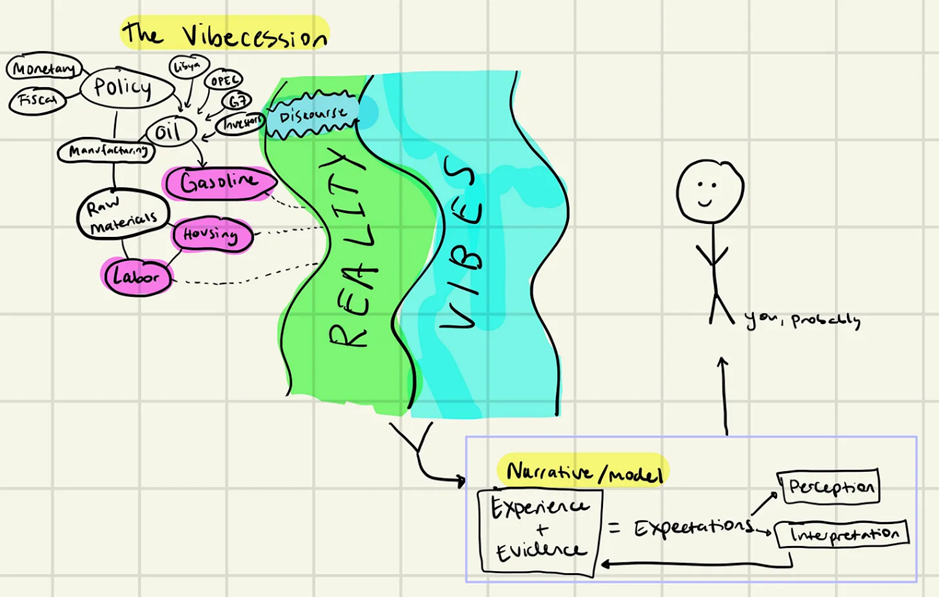
Source: Kyla’s Newsletter, “The Vibescession: The Self-Fulfilling Prophecy” (July 30, 2022). https://kyla.substack.com/p/the-vibecession-the-self-fulfilling
I guess that’s true. In a time of confusing tariffs, AND a sky-high stock market, to say that investors are getting mixed messages is an understatement. So I picked up the book. I’m glad I did.
Five Sections, Five Feelings.
“In This Economy?” is divided into five parts. Each part is filled with anecdotes, illustrations, theory and jokes. And each part made me feel a different emotion.
Here’s a screenshot of the table of contents picked up from Scanlon’s Substack”
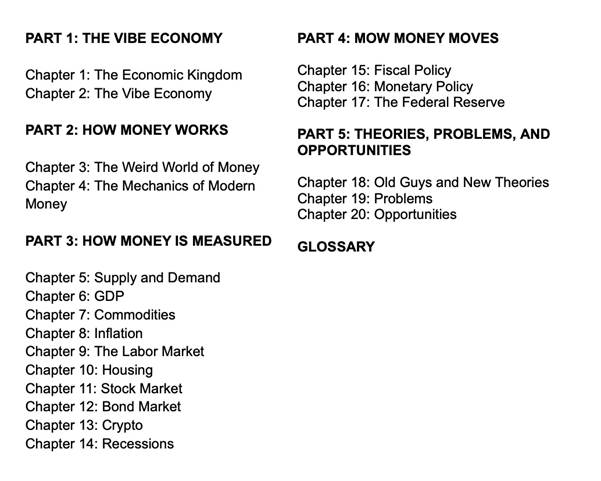
The first part set out the lay of the land. Vibecession made its appearance. It made me laugh a lot. The second section was more about money and how it works. It was easy and fun. The third part is the bulk of what made the book – it explained a lot of complicated economic ideas. Things we hear about all the time, and think we know, but sometimes of which we might have a wrong understanding. This section I mostly felt like I knew all of it, but it was a good refresher. Part four was about policy. My eyes glazed over a bit here. And then came the last section. For me, this was the most important part – it gave me a sense of how the young people in the economy today think about problems, and what they think the solutions might be.
An Economics Book for the Chronically Online
Many online reviewers of this book first encountered Scanlon through Tik Tok, or Instagram. After I read the book, I checked out a few of her videos. It immediately felt like I understood what she was going for. The charts, the doodles, the illustrations, all of them made sense when viewed through the lens of social media content creation. I particularly liked her comics of the “Inflation Narrative Path,” the “The Cake of Uncertainty” and “Fed Sets the Vibes.” Trust me, when you read the book, you’ll get it.
She liberally quotes from movies, TV shows, poets, and books. Even when discussing relatively uninteresting (to the broader public, not your esteemed columnist) ideas like fiscal policy, the Federal Reserve, the flow of capital, and the bond market, Scanlon manages to insert a chatty style, infused with both levity and clarity. Granted, these are easier to do with topics like cryptocurrencies and meme stocks, but the author manages to balance both in an easy-to-understand way, that would benefit almost anyone who picks the book up.
Money and Mental Health
One of the sections that most hit home for me was how the economy affects our mood, and our mental health. This is one aspect of the conversation that is mostly missing in financial circles but is critical when trying to talk money and Main Street.
Scanlon discusses the pandemic, and the isolation in that time, and talked about how social media amplifies anxiety and opinions. Riveting stuff.
Why Read This Book?
At the end of the day, we live in a time of extreme attention churn. So asking me, or you, or anyone to read a 300+ page book is a lot. I think “In This Economy?” is worth your time. Here’s why.
If you’re below 25 years old, and you’re interested in finance, chances are you’ve seen Scanlon on social media. The book is written for people who are used to that style and explains important economic terms that will help you navigate your own financial journey.
If you’re below 50 years old, but above 25 years old, and are not as chronically online as some others, read the book as a 1. refresher in economics and finance, and 2. as an introduction or refresher in how to get complex ideas across in an accessible way, especially if you’d like to know how to effectively speak to the world online.
If you’re above 50 years old, read this book because it explains how the young people think about finance. I’ll be the first to admit that my circle is not full of people very much younger than I am, so sometimes, I do struggle to understand what generations apart from mine think about things, and how they differ from my own understanding. This book helped me with that.
Disclaimer
The opinions and views expressed in this book are those of the author and do not necessarily reflect the views of Harvest ETFs. Similarly, the opinions and views expressed in this review are solely those of the reviewer (the Author) and do not represent the views of Harvest ETFs. The Author and Harvest ETFs have no affiliation with the author of the book.
Any investment decisions should be made in consultation with a licensed and experienced investment professional. This review is intended for educational purposes only and should not be construed as investment advice.