For much of the past decade, global equity markets have had an unmistakable centre of gravity. Investor interest, headlines, and benchmark returns all pointed toward the U.S., and international markets were treated as a hedge at best, an afterthought at worst. That gravity is shifting and international equities are back as a central part of portfolio conversations.
On a YTD 2026 basis, international equity ETFs have led inflows within the equities category — pulling in $32.79B, ahead of $18.9B into Canadian equity ETFs and $16.8B into U.S. equity ETFs and is the largest of the three regional categories. ¹
Performance has helped drive the shift: international equities, as proxied by the MSCI ACWI ex-USA Index, outpaced the S&P 500 through 2025 and YTD 2026. ²
International Stocks vs US Stocks Since January 2025
Source: Bloomberg as at July 31, 2026.
Canadian advisors have no shortage of ways to access international equity exposure. What has been more challenging is finding a solution that combines that exposure with the monthly, tax-efficient income, which Canadian investors have come to expect from domestic and U.S. covered-call strategies.
Introducing HHII
Harvest International High Income Shares ETF (HHII) is designed to provide investors diversified exposure to large, established companies outside the U.S. and Canada, paired with an actively managed covered-call overlay intended to generate monthly income. Structurally, HHII is the international leg of the Harvest High Income All-in-One series which includes Harvest Diversified High Income Shares ETF (TSX: HHIS), Harvest High Income Equity Shares ETF (TSX: HHIH) and Harvest Canadian High Income Shares ETF (TSX: HHIC).
HHII holds a curated basket of large-cap international issuers — companies domiciled outside North America with a market capitalization above C$10 billion — spanning geographies including the U.K., continental Europe, Taiwan, South Korea, and Brazil. A portion of the portfolio employs covered call options to generate premium income to support the payment of more tax-efficient monthly distributions, with the remainder left to participate in capital appreciation.
Why consider investing in international equities?
The home-bias case for going international
Diversification is one of the core principles of portfolio construction, and it applies across asset classes, sectors, market capitalizations — and across geography. However, Canadian investors, tend to carry a pronounced home bias. In a 2023 survey conducted by the International Monetary Fund, it was found that Canadians allocate approximately half (~ 50%) of their total equity exposure to Canadian equities, despite Canada representing only about 3% of global equity market capitalization. ³
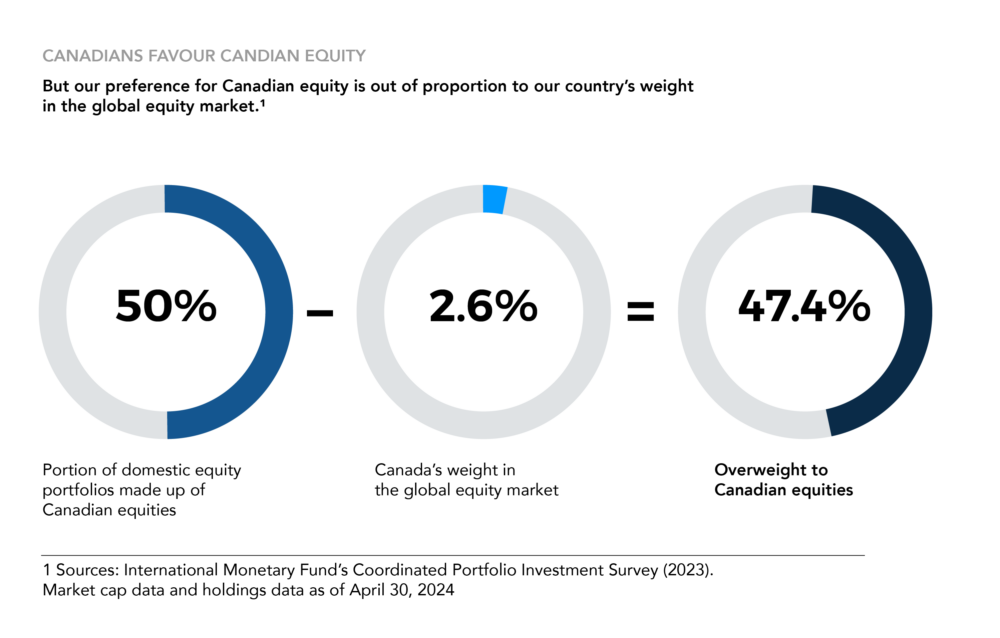
That concentration compounds a second one: the typical Canadian home-bias problem is two-layered i.e. heavy TSX weighting, then often “topped up” with US S&P 500/Nasdaq exposure.
Moving beyond the S&P/TSX 60 or the S&P 500 does not mean moving into speculative or illiquid markets. Developed international markets access helps diversify away from both economies at once, with emerging markets adding a third layer. Developed and emerging international equities include large, profitable global companies, just listed outside the US and Canada. The practical result is reducing the share of a portfolio that rises and falls with Canadian and US names, without sacrificing quality or liquidity.
HHII’s portfolio puts that layering into practice. Approximately 80% of the basket sits in developed markets—the UK, Switzerland, the Netherlands, Belgium, Finland, Sweden, Denmark, and Australia—with the remaining 20% in markets that MSCI still classifies as emerging. The result is tangible diversification away from Canada and the US, without trading down in company quality or liquidity to get the international markets layer.
Source: Harvest ETFs, July 2026.
Mitigation of Security Concentration
Put simply, both U.S. and Canadian equities are more concentrated in a smaller number of companies and sectors than the global equity market. Specifically, as of July 31, 2026, the top 10 holdings in the S&P 500® Index and the S&P/TSX Composite Index constitute 37.6% and 38.1% of their respective indexes. Conversely, the top 10 global securities make up less than 25% of the MSCI ACWI Index4. This could contribute to idiosyncratic risk, a form of risk, which is peculiar to investing in a certain geography or market and can be avoided by diversification.
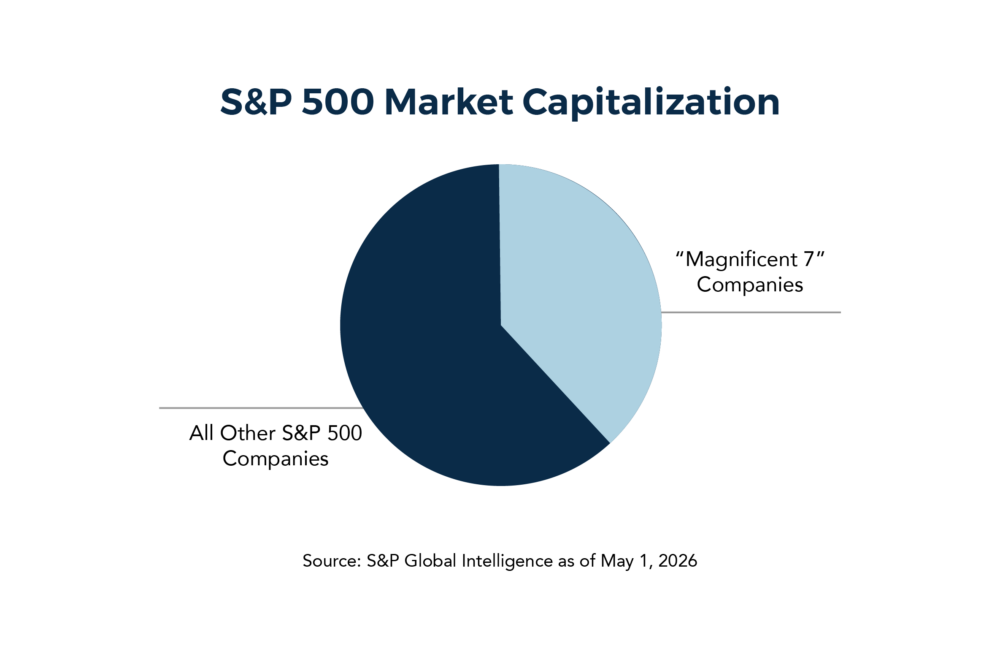
Additionally, Canada is more concentrated than the global market in three sectors: energy, financials, and materials. This means Canadian investors with home country bias may be underweighting the technology, healthcare, consumer discretionary, and consumer staples sectors, among others, potentially missing out on opportunities.
Further, US market value sits heavily in a limited number of platform companies, while the rest-of-world total is spread across dozens of companies, currencies, and economic cycles.
Access to a large share of the world’s investable companies
| Market | Approximate equity market value | % of world total |
| United States | US$75.8 trillion | 48% |
| Canada | US$4.5–5.0 trillion | 3% |
| Rest of world (all other listed markets) | US$74–75 trillion | 48–49% |
|
Market |
Approximate equity market value |
% of world total |
|
United States |
US$75.8 trillion |
48% |
|
Canada |
US$4.5–5.0 trillion |
3% |
|
Rest of world (all other listed markets) |
US$74–75 trillion |
48–49% |
Approximate, mid-2026; U.S. figure from Wilshire 5000 total market cap; Canada from TSX/TMX and CEIC market-cap series; world total and residual estimated from Bloomberg/World Federation of Exchanges compilations. Figures should be treated as order-of-magnitude, not point estimates.
Market size supports the view that international equities are not merely a satellite allocation but are an investment universe, in their own right. Even when the U.S. and Canada are excluded, the remaining global market represents a sizeable opportunity set—the U.K., the Eurozone, Switzerland, the Nordics, Taiwan, Korea, Brazil, and every other listed market—and is close in size to the U.S. market itself. The scale is easy to underestimate but excluding these countries means passing on category-leading companies.
Key HHII holdings are large-cap international companies consistent such as:

Shell PLC
Integrated energy major with operations across upstream exploration and production, refining, chemicals, and trading.

BHP Group Limited
Diversified mining company and among the world’s largest producers of iron ore, copper, and metallurgical coal.

Embraer S.A.
The world’s third-largest producer of civil aircraft, after Boeing and Airbus, spanning commercial regional jets, executive jets, and defense aircraft.

Anheuser-Busch InBev SA/NV
The world’s largest brewer by volume, with a portfolio of over 500 brands including Budweiser, Stella Artois, and Corona.

Novartis AG
Pharmaceutical company focused on innovative medicines across oncology, cardiovascular-renal-metabolic, immunology, and neuroscience, following the 2023 spin-off of its former generics division, Sandoz.

Barclays PLC
A UK-centred leader in global finance, Barclays PLC operates through UK consumer and business banking, international consumer and payments, and Barclays Investment Bank, its corporate and investment banking division.

HSBC Holdings PLC
Multinational bank operating a global network, with a substantial share of group profit generated by its Asia-Pacific business, including operations in Hong Kong and mainland China.

Nokia Oyj
A global leader in connectivity for the AI era, Nokia supplies mobile and fixed network infrastructure, including 5G equipment, to telecom carriers globally.

ASML Holding N.V.
The sole global manufacturer of extreme ultraviolet (EUV) lithography systems, a critical piece of equipment used in advanced semiconductor fabrication, ASML enables the world’s leading chipmakers to produce microchips that power today’s world.
Taiwan Semiconductor Manufacturing Company Limited
The world’s largest dedicated semiconductor foundry, manufacturing chips designed by companies including Apple, Nvidia, and AMD.

ARM Holdings PLC
Licenses chip architecture used across most of the world’s smartphones and increasingly in data-centre processors; majority-owned by SoftBank Group.

STMicroelectronics N.V.
A Swiss-based semiconductor manufacturer manufacturing chips primarily for automotive and industrial applications, powering the sensors and controllers behind electrification and automation.

SK hynix Inc.
A South Korean semiconductor company and the world’s second-largest memory chip maker, producing DRAM and NAND flash memory, including high-bandwidth memory (HBM) used in AI accelerators.

Spotify Technology S.A.
The world’s largest audio streaming platform, Spotify offers both subscription (Premium) and advertising-supported (Free) tiers.

Novo Nordisk
A 100-year-old insulin pioneer known primarily for its diabetes and obesity-care franchise, including GLP-1 receptor agonist treatments such as semaglutide, the GLP-1 therapy that created an entirely new global drug category in diabetes and obesity care.
Why now?
Rest-of-world equity is not a small allocation decision—it’s roughly as large, in aggregate, as the U.S. market itself, just fragmented across currencies and regulators in a way no single index captures cleanly. HHII acts as a single-ticket, monthly-income wrapper around large international names solves a real access and complexity problem for investors and advisors who would otherwise have to build that exposure name-by-name or accept a plain index fund with no income overlay.
¹ NBCCM, Canadian ETF Flows, June 2026.
² MSCI ACWI ex-USA Index vs. S&P 500 Index, full year 2025 and YTD July 2026. MSCI ACWI ex-USA excludes the United States but includes Canada as one of its Developed Markets constituents
³ International Monetary Fund Coordinated Portfolio Investment Survey (2023); S&P Global BMI country weights by float-adjusted market capitalization.
4 S&P/TSX Composite Index and MSCI ACWI Index Factsheet as at Julye2026.
DISCLAIMER
Commissions, management fees and expenses all may be associated with investing in Harvest High Income Shares ETFs managed by Harvest Portfolios Group Inc. (the “Funds” or a “Fund”). Please read the relevant prospectus before investing. The Funds’ returns are not guaranteed, their values change frequently, and past performance may not be repeated. Tax investment and all other decisions should be made with guidance from a qualified professional.
Distributions are paid to you in cash unless you request, pursuant to your participation in a distribution reinvestment plan, that they be reinvested into available ETF Class A Units of the Fund. If a Fund earns less than the amounts distributed, the difference is a return of capital.
Certain statements included in this communication constitute forward-looking statements (“FLS”, including, but not limited to, those identified by the expressions “expect”, “intend”, “will” and similar expressions to the extent they relate to the Funds. The FLS are not historical facts but reflect the Harvest’s and the portfolio manager of the Funds current expectations regarding future results or events. These FLS are subject to a number of risks and uncertainties that could cause actual results or events to differ materially from current expectations. Although Harvest and the portfolio manager of the Funds believe that the assumptions inherent in the FLS are reasonable, FLS are not guarantees of future performance and, accordingly, readers are cautioned not to place undue reliance on such statements due to the inherent uncertainty therein. The Funds, Harvest and the portfolio manager of the Funds undertake no obligation to update publicly or otherwise revise any FLS or information whether as a result of new information, future events or other such factors which affect this information, except as required by law.
All rights to the trademarks and/or logos listed herein belong to their respective owners and Harvest ETFs use hereof does not imply any affiliation with, or endorsement by the owners of these trademarks and/or logos.
“International Issuers” means a public company that is (i) incorporated or headquartered in a country that is not Canada or the United States of America; and (ii) has a market capitalization in excess of C$10 billion at the time of investment.