By Ambrose O’Callaghan
It has been a bumpy ride for fixed income investors in the last few years amidst sticky inflation. This has impacted the trajectory of Fixed Income ETFs like the Harvest Premium Yield Treasury ETF (TSX: HPYT) and the Harvest Premium Yield 7-10 Year Treasury ETF (TSX: HPYM).
Wars in Europe and the Middle East, a shifting policy environment, and ongoing geopolitical tension have kept inflation running hotter than many expected. That has kept the market bracing for it to stay that way. Moreover, a strengthening U.S. economy and a wave of AI-related capital spending have added their own inflationary pressure, alongside continued commodity market strength.
In an environment where inflation and inflation expectation are running high, longer-term bond yields have climbed to the higher end of their range over the past few years. When bond yields rise, bond prices fall. That relationship is at the heart of everything below.
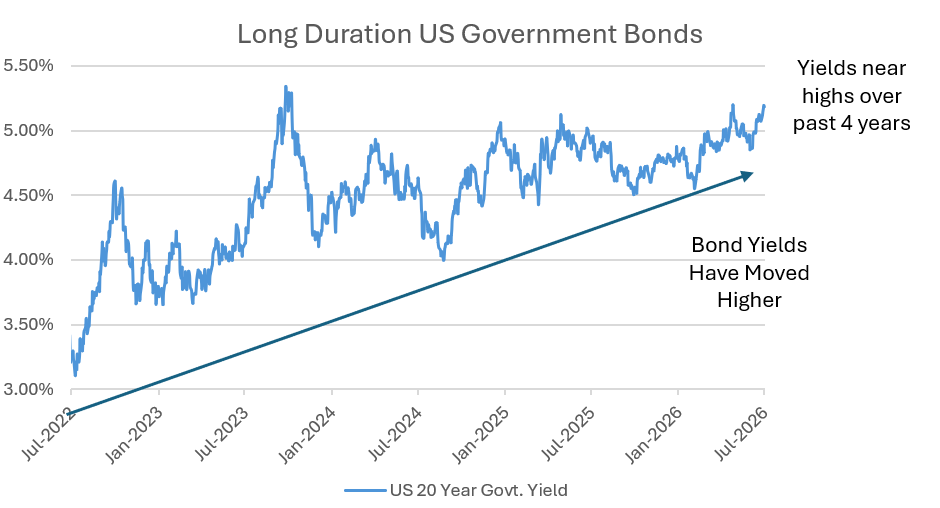
Source: Harvest Portfolios Group Inc., Bloomberg L.P., July 24, 2026
A surprising twist: Volatility has gone down
Given the recent changes charted above, one might expect bond markets to feel more turbulent than ever. But that is not what has occurred.
The MOVE Index, which is sometimes referred to as “VIX for bonds”, tracks the degree of uncertainty the market expects around future interest rates. Despite the headlines, this measure of treasury market volatility has come down.
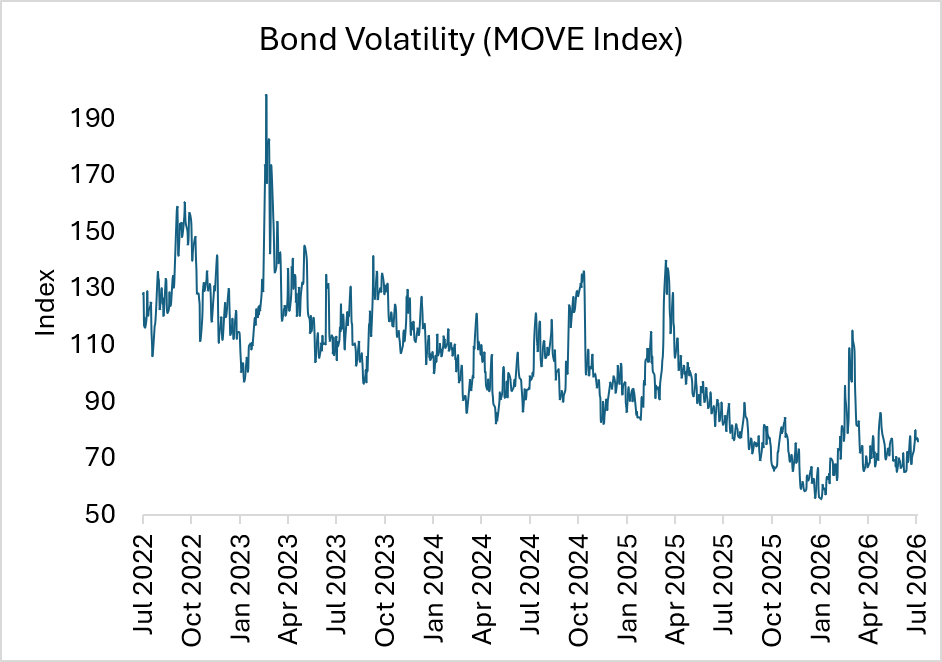
Source: Harvest Portfolios Group Inc., ICE BofA Move Index, Bloomberg L.P. , July 24, 2026.
Just as with stocks, the price of options in the bond market is heavily driven by volatility. When volatility goes down, so does the premium available from strategies that sell (or “write”) options. This includes covered call option writing strategies.
Since the launch of the Harvest Premium Yield Treasury ETF (TSX: HPYT) and the Harvest Premium Yield 7-10 Year Treasury ETF (TSX: HPYM), treasury market volatility has settled down considerably from the elevated levels we witnessed in 2022 and 2023. This shows up both in the broader MOVE Index and in the options markets for the funds’ underlying holdings, the iShares 20+ Year Treasury Bond ETF (NASDAQ: TLT) and the iShares 7-10 Year Treasury Bond ETF (NASDAQ: IEF) . Lower volatility means lower option premiums. That directly affects how much cash flow the covered call strategy can generate.
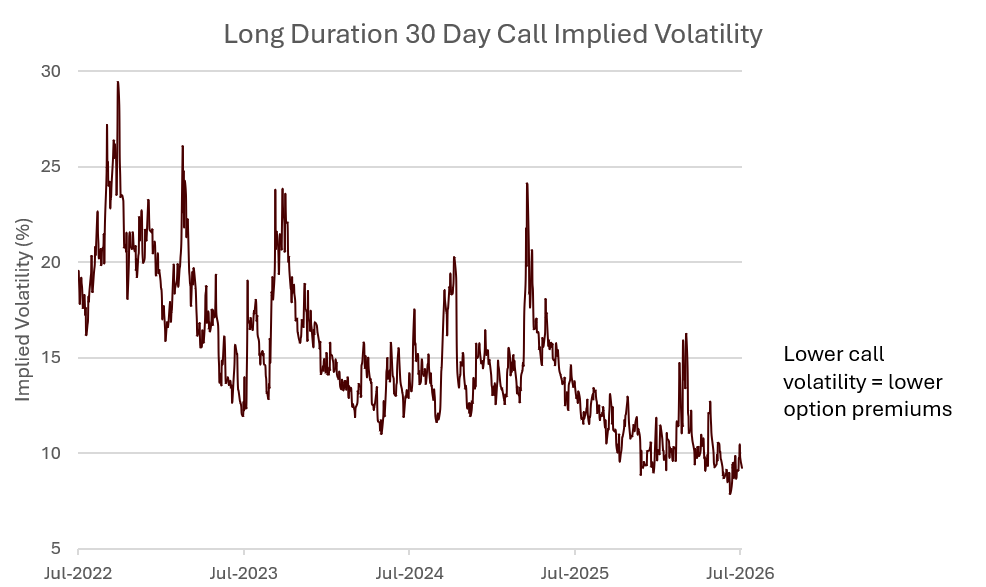
Source: Bloomberg L.P., Represents the 30 day call implied volatility for the iShares 20+ Year Treasury Bond ETF. Volatility is the key driver for call option premium and cash flow generated from options.
Why this current environment is tricky
Fixed income investors face a balancing act right now. Longer-duration bonds offer attractive yields today, plus the potential for price increases if interest rates fall. However, getting there has not been a straight line. Ongoing uncertainty at the long end of the yield curve keeps investor sentiment on edge.
For anyone using a covered call treasury strategy, this creates a genuine trade off. How much income do you want to generate right now, versus how much room do you want to leave to benefit if bond prices rise later?
Why have distributions changed?
Option premiums are a key ingredient in the income generated by HPYT and HPYM.
When implied volatility falls, there are fewer premiums available to collect and pass along to investors as distributions. That is not a reflection of anything going wrong with the ETFs. Instead, it is a direct function of current market conditions.
It is also worth understanding a deliberate design choice: The ETFs could write call options on 100% of the portfolio, but they do not. Instead, HPYT and HPYM write calls on only a portion of their holdings. This is intentional.
By writing calls on less than the full portfolio, the ETFs aim to:
- Keep generating meaningful monthly cash flow
- Stay exposed to treasury yields
- Preserve room to benefit if bond prices rise
- Strike a balance between income and total return, especially after periods when bond prices have already fallen
Writing fewer calls means somewhat less income today, but more upside potential if rates come down and bond prices recover. This is a trade-off made on purpose, not a side effect.
Looking ahead
Today’s treasury market appears calmer than it did during the volatility spikes that followed aggressive central bank hikes. And yes, option premiums have fallen down alongside that calmer volatility. However, investors are still starting from a higher overall yield base than they have seen for most of the past decade.
Looking forward, Harvest believes treasury covered call strategies can still play a valuable role in a portfolio by offering:
- Exposure to high-quality U.S. government bonds
- Attractive monthly cash flow
- Potential for further gains if interest rates decline
- Active, adaptive options management that responds to changing market conditions
As volatility continues to normalize and the yield curve adjusts, HPYT and HPYM remain focused on the same goal: Delivering income today while keeping the door open to participate in potential gains from longer-duration bonds down the road.
The bottom line
Recent distribution changes in HPYT and HPYM come down to two main factors: Lower treasury market volatility, and a deliberate strategy of not writing calls on 100% of the portfolio. This is a choice made specifically to avoid capping the ETFs’ ability to benefit from rising bond prices.
Yes, this means a somewhat lower income from options in the near term. But, it also means the ETFs are better positioned to participate in potential gains if long-term treasury yields eventually move lower.
Disclaimer
This communication should not be considered as advice and/or a recommendation to purchase or sell the mentioned securities or used to engage in personal investment strategies. Tax, investment and all other decisions should be made with guidance from a qualified professional.
Commissions, management fees and expenses all may be associated with investing in Harvest Exchange Traded Funds (managed by Harvest Portfolios Group Inc.). Please read the relevant prospectus before investing. The funds are not guaranteed, their values change frequently and past performance may not be repeated.
Certain statements included in this communication constitute forward-looking statements (“FLS”, including, but not limited to, those identified by the expressions “expect”, “intend”, “will” and similar expressions to the extent they relate to the Funds. The FLS are not historical facts but reflect the Harvest’s and the portfolio manager of the Funds current expectations regarding future results or events. These FLS are subject to a number of risks and uncertainties that could cause actual results or events to differ materially from current expectations. Although Harvest and the portfolio manager of the Funds believe that the assumptions inherent in the FLS are reasonable, FLS are not guarantees of future performance and, accordingly, readers are cautioned not to place undue reliance on such statements due to the inherent uncertainty therein. The Funds, Harvest and the portfolio manager of the Funds undertake no obligation to update publicly or otherwise revise any FLS or information whether as a result of new information, future events or other such factors which affect this information, except as required by law.