By Ambrose O’Callaghan
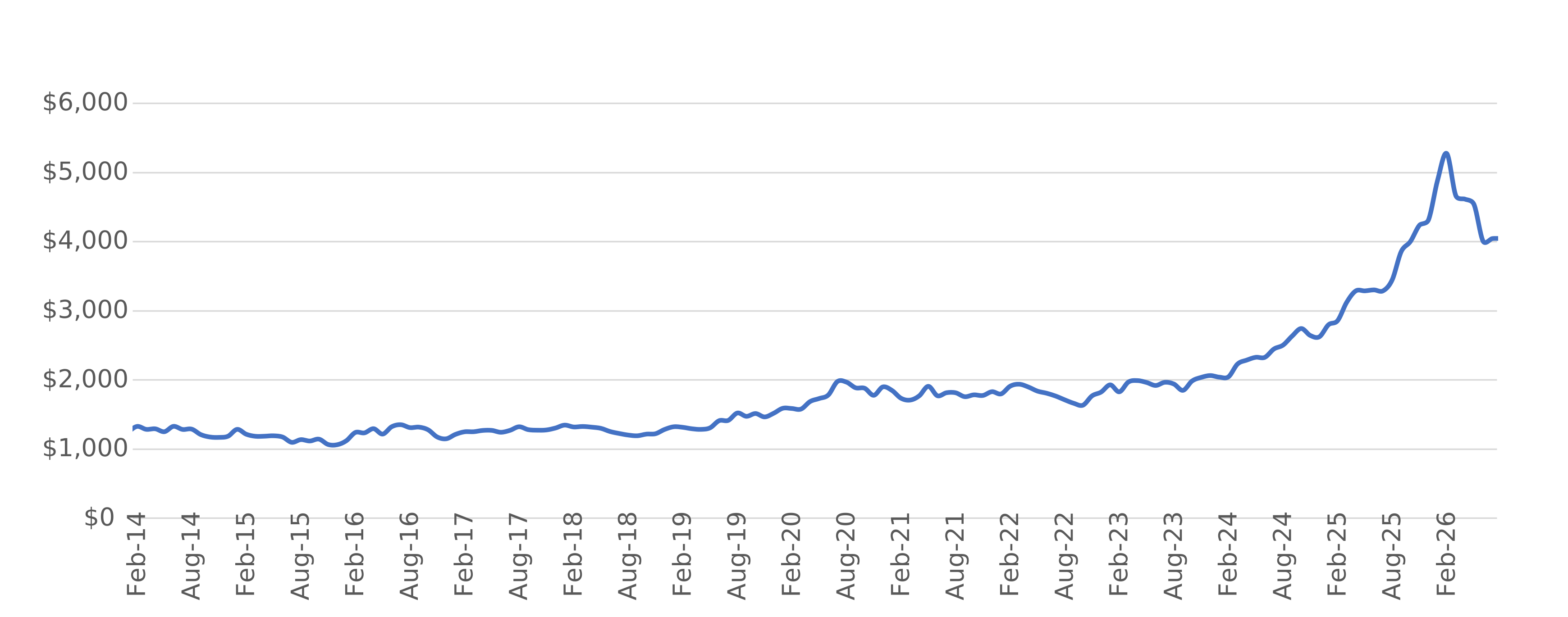
Gold has ascended to record highs since the start of 2025, proving to be one of the defining stories in the market at the midway point of the decade. Indeed, the yellow metal has rewarded patience as much as conviction with its run up in 2025 and 2026. The spot price of gold bullion was priced just over US$2,500 per ounce starting 2025 and finished up the year nearly 60%. That momentum carried into the New Year in 2026, with gold surging to an all-time high of over $5,500 an ounce in late January.
The gold rally hit turbulence due to the escalating US-Iran military conflict, pushing oil and inflation expectations higher. This prompted markets to price out Federal Reserve rate cuts, spurring the yellow metal to lose more than 10% in the month of March alone. That was its worst monthly decline since 2013.
Gold Price in USD/oz Since 2014
Source: Bloomberg, July 31, 2026
Gold has held onto the bulk of its gains heading into the summer of 2026. That has left investors to ponder the future of the world’s oldest store of value.
The different ways to own gold
Investors have often leaned on gold in two distinct ways: bullion and equities.
Gold bullion, which is represented in physical bars, coins, and the ETFs that track the spot price directly, has served its traditional role as a store of value and a hedge against currency debasement, fiscal uncertainty, and geopolitical shocks. Rising sovereign debt and eroding confidence in fiat monetary systems have driven both physical bar purchases and large institutional buying. Meanwhile, global gold ETF inflows reached a record US$89 billion in 2025. The appeal of gold bullion is in its simplicity: Bullion does not default, does not dilute, and moves largely in line with the yellow metal itself. That is why long-term allocators, and central banks favour it as a ballast.
Gold equities, which are represented by gold miners and the ETFs built around them, offer a different exposure entirely. Miners carry operating leverage to the gold price. Their earnings, and respective share prices, tend to amplify moves in the underlying metal, for better and worse. Mining ETFs outperformed gold spot by more than 2x in 2025.
Take the Harvest Global Gold Giants Index ETF (TSX: HGGG) as an example. This ETF is designed to give investors gold exposure through profitable large-scale gold miners. HGGG has climbed 87% over a 1-year period as at June 30, 2026.
Annual Performance
As at 2026/09/30
| Ticker | 1M | 3M | 6M | YTD | 1Y | 2Y | 3Y | 4Y | 5Y | 6Y | 7Y | SI |
|---|---|---|---|---|---|---|---|---|---|---|---|---|
| HGGG | (8.11) | 17.27 | (0.67) | 5.59 | 24.09 | 64.07 | 59.08 | 45.59 | 31.19 | 17.75 | 22.58 | 22.89 |
HPYG | Gold bullion & gold equities with monthly income
The Harvest Premium Yield ETF (TSX: HPYG) was launched on Tuesday, July 7, 2026. HPYG stands as an option for investors who want both sides of the equation; gold bullion and leading gold equities. That combined approach offers exposure to gold bullion and gold equities, pairing the ballast of physical gold with the torque of producer stocks in a single vehicle.
HPYG also offers the Harvest premium yield strategy. It is overlaid with an active option strategy, utilizing calls and puts, to generate monthly cash distributions. HPYG applies moderate leverage to enhance its monthly yield and bolster long-term growth potential.
Summary
Gold has managed to deliver one of the defining market stories of the decade. Investors have captured this run through two complementary vehicles: Gold bullion, prized for its simplicity and role as a hedge against currency debasement and political risk, and gold equities, which carry operating leverage that amplify gold’s moves. The newly launched Harvest Premium Yield Gold ETF (TSX:HPYG) combines both exposures in a single ETF, while laying on an active options strategy, with moderate leverage, to convert gold’s historic run into high monthly cash distributions.
Disclaimer
Commissions, management fees and expenses all may be associated with investing in Harvest Exchange Traded Funds (managed by Harvest Portfolios Group Inc.). Please read the relevant prospectus before investing. The indicated rates of return are the historical annual compounded total returns (except for figures of one year or less, which are simple total returns) including changes in unit value and reinvestment of all distributions and do not take into account sales, redemption, distribution or optional charges or income taxes payable by any securityholder that would have reduced returns. The funds are not guaranteed, their values change frequently and past performance may not be repeated.
Distributions are paid to you in cash unless you request, pursuant to your participation in a distribution reinvestment plan, that they be reinvested into Class A units of the Fund. If a Fund earns less than the amounts distributed, the difference is a return of capital.
The Fund is categorized as a liquid alternative ETF. This means it has the ability to use leverage and can invest more than 10% of its assets in a single issuer. The Fund employs modest leverage, which can amplify both gains and losses.
Certain statements included in this communication constitute forward-looking statements (“FLS”, including, but not limited to, those identified by the expressions “expect”, “intend”, “will” and similar expressions to the extent they relate to the Funds. The FLS are not historical facts but reflect the Harvest’s and the portfolio manager of the Funds current expectations regarding future results or events. These FLS are subject to a number of risks and uncertainties that could cause actual results or events to differ materially from current expectations. Although Harvest and the portfolio manager of the Funds believe that the assumptions inherent in the FLS are reasonable, FLS are not guarantees of future performance and, accordingly, readers are cautioned not to place undue reliance on such statements due to the inherent uncertainty therein. The Funds, Harvest and the portfolio manager of the Funds undertake no obligation to update publicly or otherwise revise any FLS or information whether as a result of new information, future events or other such factors which affect this information, except as required by law.