By Ambrose O’Callaghan
You turn on a light to read a book.
The water flows when you turn on the tap.
Your phone is connected while you scroll and stay in touch with your friends and family.
These are everyday conveniences most of us rarely think about. But, behind them sits a network of essential businesses that keeps homes, industries, and economies running.
For investors, utilities have long been associated with dependable demand, dividend income, and defensive characteristics. Meanwhile, the sector continues to evolve. Aging infrastructure, the expansion of artificial intelligence (AI), and the transition toward new sources of energy are creating significant investment needs across the global utilities landscape.
For Canadian investors, this presents an opportunity to look beyond traditional domestic utilities and consider the potential benefits of global exposure.
Utilities: Essential businesses in a changing economy
Electricity, natural gas, water, telecommunications, and energy infrastructure are fundamental to modern life. Unlike many discretionary products and services, demand for these essentials tends to persist through different economic conditions.
Many utility businesses also operate within regulated frameworks that can support predictable revenues and cash flows. This combination of essential services and established operations has historically made utilities an important consideration for investors seeking dividend income and a more defensive component in their portfolios.
However, the utilities sector has an appeal that extends beyond its traditional characteristics. The infrastructure that powers everyday life is becoming increasingly important in some of the world’s fastest-growing industries.
Why global diversification matters
HUTL portfolio manager Mike Dragosits previously detailed the advantages of a global utilities portfolio, compared to more domestic-oriented portfolios: The Advantages of a Global Utilities Portfolio | Harvest Market Minutes.
Utilities represent essential services. However, they face risks from climate events and regulatory shifts. HUTL’s global, equal-weighted approach spreads exposure across regions and reduces concentration risk, helping mitigate regulatory risk as well as country-specific challenges such as wildfires, storms, or political shifts.
A globally diversified portfolio can also provide access to businesses operating in different markets, broadening exposure beyond the Canadian utilities sector. For example, U.S. utilities may offer access to regions experiencing rapid data-centre development, while European companies may provide exposure to different energy markets and infrastructure investment priorities. Telecommunications and pipeline businesses add further exposure to the networks that support modern economies.
These benefits do not eliminate risk. Global utility investments remain sensitive to interest rates, market conditions, regulation, currency movements, and company-specific developments. However, looking across multiple regions can broaden the range of businesses and investment opportunities represented in a portfolio.
How AI is driving a new weave of electricity demand
Earlier this year, we examined how the development of AI is driving a utilities growth surge.
Indeed, the growth of generative AI, and the explosion of demand for its services, has laid a new burden on our present-day infrastructure. Large language models (LLMs) like Chat GPT can generate ideas, compose emails, proofread content, write code, create images and videos, and more with just a simple prompt. However, these tasks consume much more energy than, for example, a simple good search.
Energy Consumption of Generative AI Models
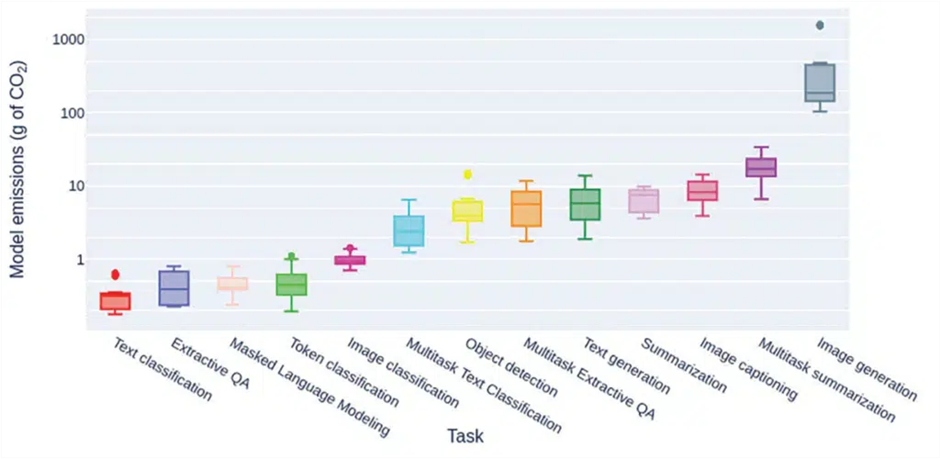
Source: “Generative AI: Energy Consumption Soars”, Polytechnique Insights. November 13, 2024.
The chart above illustrates the model emissions from generative AI tasks, with image generation standing above the others. Another example is BLOOM, the world’s largest open multilingual LLM. Scientists have estimated that training the BLOOM AI emits approximately 10 times more greenhouse gases than the average French citizen in calendar year.
This growth has major implications for the utilities responsible for generating, transmitting, and distributing electricity. Meeting rising demand may require new power generation, expanded transmission networks and upgrades to existing infrastructure. The opportunity is not limited to companies directly involved in AI. Utilities operating in regions with growing data-centre activity may benefit from increased demand for electricity and the associated need for infrastructure investment.
Meanwhile, much of North America’s electricity infrastructure is aging. Public and private entities are working to modernize existing grids while accommodating new sources of demand. This creates another potentially explosive investment opportunity for the long term.
Together, AI adoption and infrastructure renewal are helping reshape the long-term outlook for utilities. Individual companies are sure to face different challenges and opportunities. Regardless, the utilities sector provides access to the physical infrastructure supporting the digital economy.
The energy transition adds another growth driver
AI is not the only force changing the utilities landscape. The global energy system is also undergoing a significant transformation as electricity generation evolves and economies around the world invest in new infrastructure.
United Utilities Group, a holding in the Harvest Global Utilities Income ETF (TSX: HUTL)[i], announced in August 2026 a decision by Ofwat to provisionally approve £975 million of new investment. This adds to the £13 billion of infrastructure upgrades that are already planned by United Utilities by 2030.
In September 2026, Google announced that it would invest US$15 billion in AI infrastructure in Finland’s Fortum Oyj, another holding in HUTL. This will include the construction of at least three new data centres and the expansion of an existing data centre.
Enbridge, another top holding in HUTL, is a Canadian pipeline and energy company. In October Enbridge began a $4 billion pipeline expansion to boost natural gas capacity.
Renewable energy sources, including wind and solar, are becoming increasingly important parts of electricity systems. Integrating these sources requires investment in transmission networks, grid modernization, energy storage, and other technologies that help maintain reliable power delivery. Meanwhile, for some regulated utilities, approved infrastructure investment can expand their rate base and potentially support future earnings.
These developments do not guarantee stronger returns, and the economics of these large projects depend on many factors including financing costs, regulation, expenses, and execution, to name a few. Nevertheless, they demonstrate why utilities deserve consideration going forward.
H2 HUTL: Global utilities and monthly income in one ETF
The Harvest Utilities Leaders Income ETF invests in an equally weighted portfolio of 30 global utilities companies. These companies cover electric utilities, telecom, oil and gas storage, and transportation. HUTL is overlaid with an active covered call writing strategy to generate monthly income.
Annual Performance
As at 2026/09/30
| Ticker | 1M | 3M | 6M | YTD | 1Y | 2Y | 3Y | 4Y | 5Y | 6Y | 7Y | SI |
|---|---|---|---|---|---|---|---|---|---|---|---|---|
| HUTL | (4.92) | (3.88) | (6.57) | 4.01 | 4.97 | 9.13 | 13.71 | 10.87 | 7.49 | 8.92 | 5.12 | 6.41 |
The Harvest Utilities Leaders Enhanced Income ETF (TSX: HUTE)[ii] seeks to provide higher levels of monthly income and growth potential by investing in HUTL and applying modest leverage of approximately 25%.
Annual Performance
As at 2026/09/30
Essential today and more important tomorrow
Utilities remain fundamental to everyday life, but the investment story is evolving. Rising electricity demand from AI and data centres, aging infrastructure, grid modernization, and the global energy transition are creating new investment needs across the sector.
For investors, global diversification offers a way to access businesses operating across different markets and industries, while an income-focused strategy can complement the sector’s dividend-paying characteristics.
HUTL and HUTE brings these elements together, offering Canadian investors global utilities exposure and the potential for enhanced monthly income through covered calls.
Disclaimer
Commissions, management fees and expenses all may be associated with investing in Harvest Exchange Traded Funds, managed by Harvest Portfolios Group Inc. Please read the relevant prospectus before investing. The funds are not guaranteed, their values change frequently, and past performance may not be repeated.
Distributions are not guaranteed and may include a return of capital. Covered call strategies can limit potential gains on the portion of the portfolio subject to written calls and do not eliminate the risk of loss. This article is for informational purposes only and should not be considered investment, tax or financial advice. Investors should consult a qualified professional when making investment decisions.
The indicated rates of return are the historical annual compounded total returns (except for figures of one year or less, which are simple total returns) including changes in unit value and reinvestment of all distributions and do not take into account sales, redemption, distribution or optional charges or income taxes payable by any securityholder that would have reduced returns.
Certain statements in this communication constitute forward-looking statements (“FLS”). These statements are not historical facts but reflect the current expectations of Harvest, the Fund’s manager, regarding future results or events, and are subject to risks and uncertainties that could cause actual results to differ materially. Although Harvest believes the underlying assumptions are reasonable, FLS are not guarantees of future performance, and undue reliance should not be placed on them. Harvest undertakes no obligation to update or revise any FLS, except as required by law.
[i] Formerly Harvest Equal Weight Global Utilities Income ETF
[ii] Formerly Harvest Equal Weight Global Utilities Enhanced Income ETF