By Ambrose O’Callaghan
Healthcare stands apart as an essential, diversified, and innovation-led sector. The Harvest Healthcare Leaders Income ETF (TSX: HHL), Canada’s largest healthcare ETF – now over $1.8 billion in AUM – captures exposure to this space through twenty large-cap healthcare leaders. HHL possesses over ten years of history, paying consistent monthly distributions, which have recently been hiked to $0.06 per unit, over that period.
Earlier this month, HHL was named a FundGrade A+ Award winner by Fundata Canada Inc. The award recognizes Canadian investment funds that have delivered strong, risk-adjusted performance over multiple time periods.
In this piece, there are four areas that we want to focus on from an investor perspective:
- Investing in healthcare from a Canadian perspective
- Long-term secular drivers
- Policy clouds versus potential catalysts
- HHL portfolio positioning
Investing in healthcare from a Canadian perspective
Healthcare is made up of diversified sub-sectors with many unique drivers, as the chart below illustrates.
Healthcare Diversified Sub-Sectors with Unique Drivers
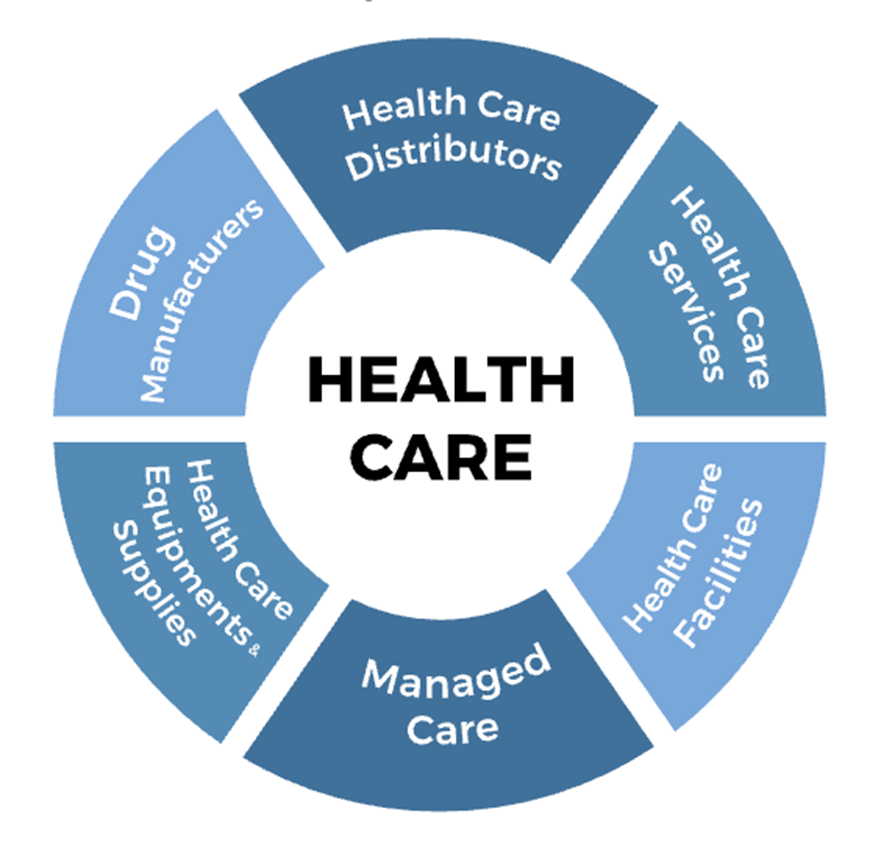
Healthcare can be broken down further into many other crucial areas including biologics, healthcare services, medical devices, managed care, diagnostics, lab testing, and surgical equipment.
From a geographic perspective, Canadians are faced with certain realities when it comes to investing in healthcare on the domestic front. While Canada is home to many wonderful companies, many of them oligopolies, there are very limited investment vehicles for Canadian investors to access healthcare companies at scale. However, these opportunities are available in the U.S. and global markets.
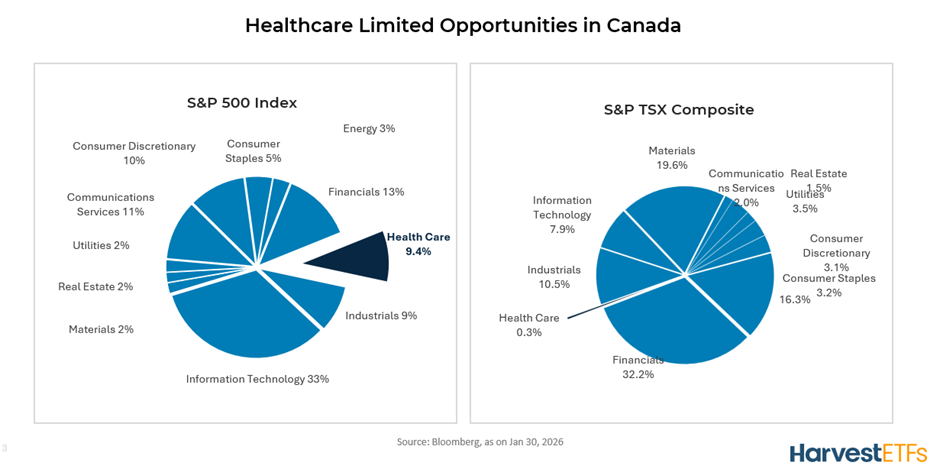
The Harvest Healthcare Leaders Income ETF provides that access. It holds 20 equities that represent nearly 1.7 times the market cap of the entire S&P/TSX Index. Canada represents less than one percent of global healthcare market capitalization. The U.S. and global markets are measured in double digits.
Indeed, the twenty companies in HHL alone are significantly larger than the entire Canadian healthcare segment in broad benchmarks.
Market Cap of 20 Stocks in HHL ($CAD) vs. S&P/TSX Composite Index
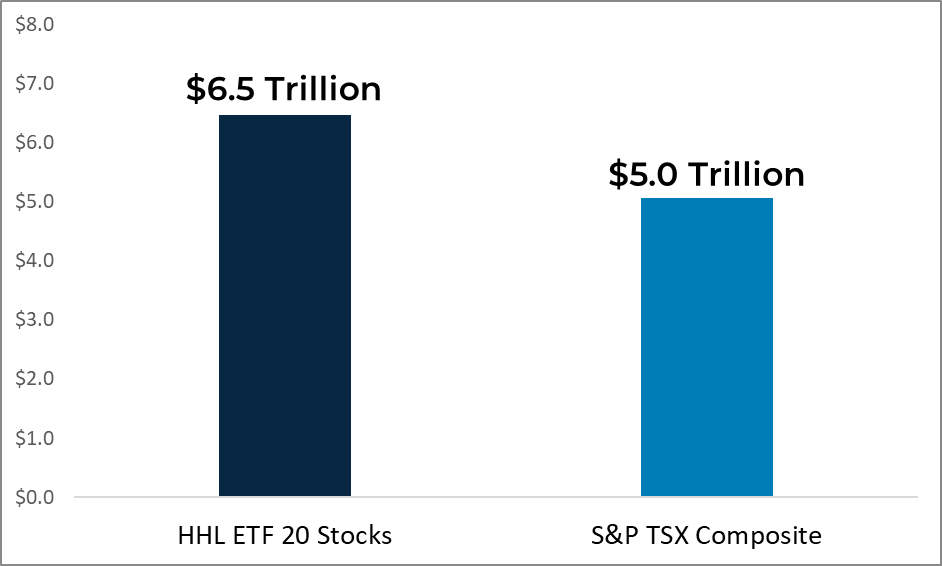
Source: Bloomberg, as at January 30, 2026.
For Canadian investors, global exposure is essential to access the true scale and innovation of the healthcare sector.
Long-Term Secular Drivers
There are three permanent, non-cyclical drivers that underpin our positive long-term outlook for the healthcare sector going forward.
Aging demographics
Population trends across the developed world remain apparent. The 65+ demographic is set to double from 2024 to 2054. By 2050, one in six people globally will be over the age of 60. Countries with high average earnings – Japan, Germany, Monaco, to name a few – lead this trend.
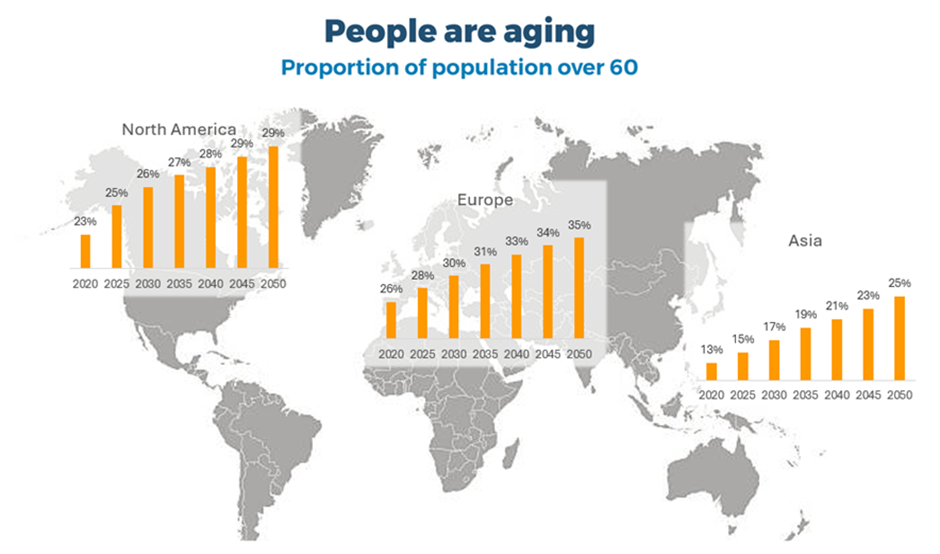
Source: United Nations Population Division; World Population Prospects, 2024.
As populations age, healthcare spending increases exponentially.
Aging Populations Spend More
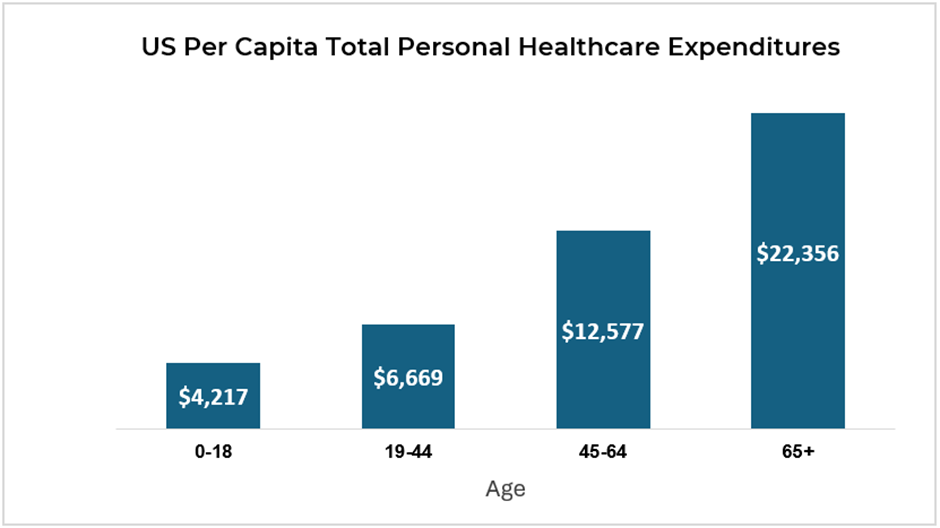
Source: NHE Fact Sheet. CMS Gov, www.cms.gov/data-research/statistics-trends-and-reports/national-health-expenditure-data/nhe-fact-sheet. Accessed February 2026. Based on 2020 calendar year.
Technological innovation
Wearable health monitoring devices have attracted attention in recent years. These range from consumer-grade smartwatches, continuous glucose monitors (CGMs), smart clothing for biometric tracking, wearable pulse oximeters, and more. However, we are seeing transformative advances in many other areas.
GLP-1 therapies have dominated headlines. Novo Nordisk’s Ozempic and Eli Lilly’s Zepbound have posted massive global sales, and demand has continued to grow. Moreover, we have seen advances in CRISPR gene editing. This technology edits genes by precisely cutting DNA and harnessing natural DNA repair processes to modify the gene in the desired manner.
We have also witnessed the continued evolution of robotic-assisted surgery. That market is predicted to achieve significant growth into the next decade.
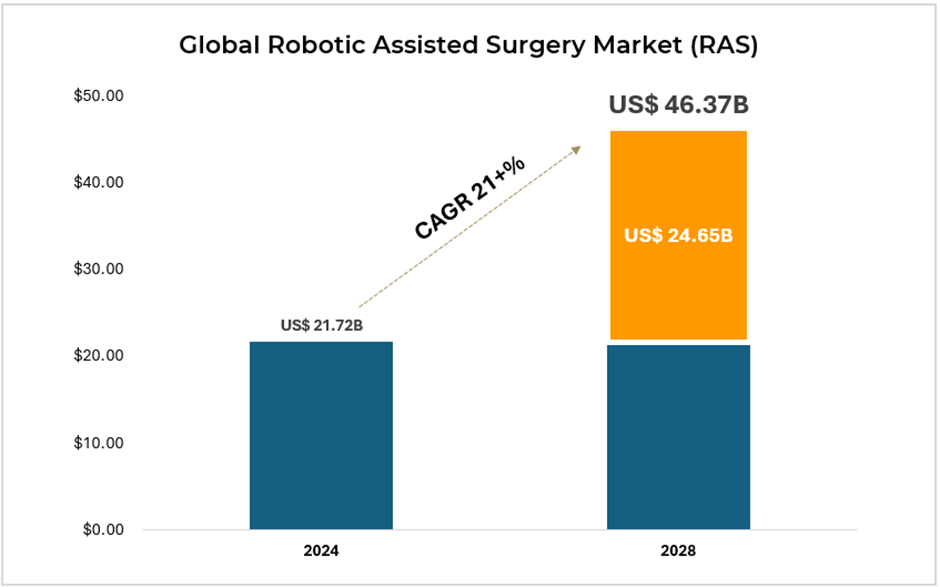
Source: ltd, R. and M. (n.d.). Global Surgical Robot Market (by type & region): Insights & Forecast with potential impact of Covid-19 (2024-2028). Research and Markets – Market Research Reports – Welcome. https://www.researchandmarkets.com/reports/5531032/global-surgical-robot-market-by-type-and-region
Developing markets
As wealth rises in emerging economies, healthcare spending will also increase disproportionately.
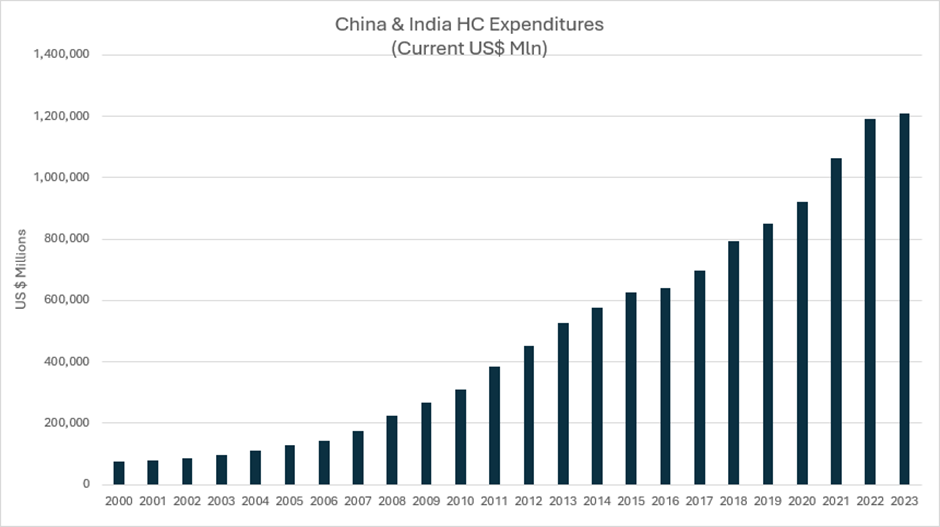
Source: WHO Global Health Expenditure Database, Harvest Portfolios Group Inc., most recent as of February, 2026.
These structural drivers form the foundation of our long-term constructive view of the healthcare sector.
Policy Clouds Versus Potential Catalysts
In the first quarter of 2025, healthcare delivered a strong performance. The sector thrived in the face of broader trade uncertainty and other macroeconomic headwinds. However, a cloud of uncertainty crept into healthcare as we progressed further in 2025. Now, as we sit well into the first two months of 2026, the sector still awaits catalysts as pro-growth technology and AI leadership dominates markets.
Policy uncertainty has weighted on sentiment in this space. Some of these risks include most-favoured nation drug pricing discussions, the fate of the Inflation Reduction Act, Medicaid reform, and concerns over managed care outlook.
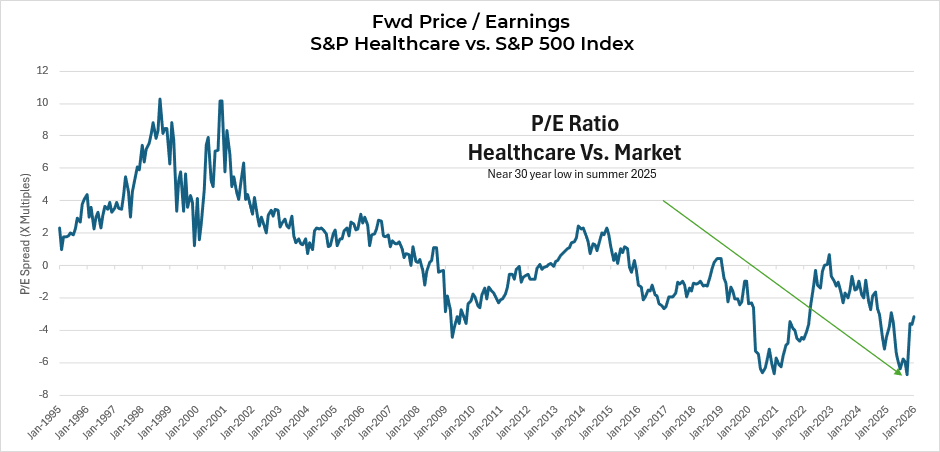
Source: Harvest Portfolios Group Inc., Bloomberg, December, 2025. S&P 500 HC Index Premium / Discount to S&P 500 based on forward 4 Quarters consensus P/E. As at January 31, 2026.
Valuations against the broader market reached a 30-year low in the summer of 2025. Still, as we have reiterated previously, valuations alone do not suggest a market bottom. However, it does reflect significant pessimism.
Through the end of the summer of 2025, there were notable allocations to the healthcare sector from the likes of Warren Buffett. Late last year, Berkshire Hathaway revealed a significant stake in UnitedHealth, acquiring over US$1.5 billion worth of shares. These allocations were coupled with second and third quarter earnings that proved resilient and put a floor on selling pressure. This resulted in fund flows into the healthcare sector that turned positive, spurring a recovery into year end.
Healthcare is considered a “superior good”. Demand for healthcare services persists in both bull and bear markets. This most recent quarterly earnings season reinforced that resiliency. Valuations in the healthcare space appear attractive in the current climate. Meanwhile, prior headwinds have moderated, with markets seeing some rotations into areas considered more defensive in the early part of 2026.
HHL Portfolio Positioning
The Harvest Healthcare Leaders Income ETF provides diversified exposure across healthcare sub-sectors. Long-term drivers are shared across those sub-sectors. However, short-term catalysts often differ. This helps to smooth the overall experience when specific policy or regulatory concerns arise that impact a particular area more than another. Stock selection is also a crucial element for positioning within sub-sectors.
Annual Performance
As at June 30, 2026
| Ticker | 1M | 3M | 6M | YTD | 1Y | 2Y | 3Y | 4Y | 5Y | 7Y | 8Y | 10Y | 11Y | SI |
|---|---|---|---|---|---|---|---|---|---|---|---|---|---|---|
| HHL | 3.75 | 2.67 | (3.68) | (3.68) | 8.77 | 1.25 | 5.09 | 6.00 | 5.84 | 8.22 | 7.55 | 6.82 | 6.21 | 6.38 |
| HHL.B | 6.91 | 5.16 | 0.37 | 0.37 | 15.27 | 4.76 | 8.92 | 9.84 | 9.75 | - | - | - | - | 9.95 |
| HHL.U | 3.92 | 3.15 | (2.87) | (2.87) | 10.68 | 2.89 | 6.48 | 7.21 | 6.84 | 9.29 | 8.62 | - | - | 8.71 |
Portfolio strategy
Harvest ETFs takes a pragmatic approach, focusing on established healthcare leaders rather than more speculative small-cap biotech or peripheral “health-adjacent” businesses.
Portfolio of large-cap healthcare leaders

HHL is an equal weighted, actively managed portfolio of twenty global healthcare leaders, diversified across sub-sectors. The ETF possesses over ten years of disciplined execution, the same investment management team, and consistent and growing monthly income. HHL is positioned to benefit as we look forward for the sector to resume its longer-term growth trajectory.
Disclaimer
Commissions, management fees and expenses all may be associated with investing in Harvest Exchange Traded Funds managed by Harvest Portfolios Group Inc. (the “Funds”). Please read the relevant prospectus before investing. The Funds are not guaranteed, their values change frequently, and past performance may not be repeated. Distributions are paid to you in cash unless you request, pursuant to your participation in a distribution reinvestment plan, that they be reinvested into available Class units of the Fund you own. If a Fund earns less than the amounts distributed, the difference is a return of capital.
Certain statements included in this communication constitute forward-looking statements (“FLS”), including, but not limited to, those identified by the expressions “expect”, “intend”, “will” and similar expressions to the extent they relate to the Fund. The FLS are not historical facts but reflect Harvest’s, the Manager of the Fund, current expectations regarding future results or events. These FLS statements are subject to a number of risks and uncertainties that could cause actual results or events to differ materially from current expectations. Although Harvest, the Manager of the Fund, believes that the assumptions inherent in the FLS are reasonable, FLS are not guarantees of future performance and, accordingly, readers are cautioned not to place undue reliance on such statements due to the inherent uncertainty therein. Harvest, the Manager of the Fund, undertakes no obligation to update publicly or otherwise revise any FLS or information whether as a result of new information, future events or other such factors which affect this information, except as required by law.