By Ambrose O’Callaghan
The price of gold has more than doubled since the start of 2023 as we enter the final weeks of 2025. Gold’s price climbed above the US$4,000 per ounce mark earlier in the fall season. This rise has coincided with falling interest rates and increased asset purchasing programs by major central banks. At the end of 2024, gold overtook the Euro as the second-largest component of central bank reserves after the US dollar. Gold now comprises over 20% of central bank assets.
Today, we will look at what other factors have contributed to gold’s continued momentum and take a closer look at two Harvest ETFs that invest in the world’s premier gold miners. One is part of the Harvest High Income Shares™ lineup of ETFs. These single stock ETFs seek to provide high monthly income and exposure to top companies. The other is part of Harvest’s Specialty ETF lineup, which pursues pure equity strategies for growth and stability. Let’s jump in.
What is driving gold’s bull run?
Gold price surged above the $4,000 mark on October 7, 2025. In just one year, the spot price of gold has climbed over 50%. Some of the factors and developments that contributed to gold’s bull run have included:
Geopolitics
In 2022, Russia launched its invasion of Ukraine. This sparked a run to gold as a safe haven. The early 2020s have also been dominated by escalating tensions between China and Taiwan, and the Israel-Hamas conflict. These geopolitical conflicts have stirred uncertainty and fear in the global financial system. Unsurprisingly, investors have turned to gold as the reliable hedge.
Monetary policy
Central banks have also moved to purchase more gold in this period. That has led to increased demand for the yellow metal. Central banks purchased 1,082 tonnes of gold in 2022, 1,037 in 2023, and a record 1,180 tonnes of gold in 2024. The Bank of England was seen moving gold from vaults back to their domestic reserves. This trend has also been witnessed in countries like the United States and India. Central banks now hold more gold than US Treasuries, for the first time in three decades.
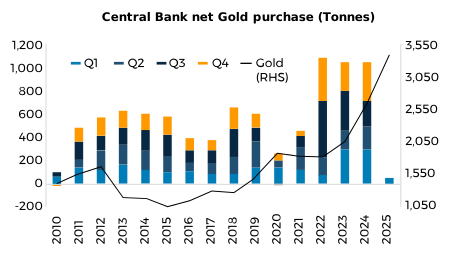
Source: Reuters; Motilal Oswal
Tariff turmoil
Gold was trading at around US$2,900 per ounce in early 2025. President Donald Trump began to pursue his aggressive tariff policy in the late winter. The simmering trade war has caused gold prices to soar in the first two thirds of the year. Indeed, lingering uncertainties surrounding trade between countries and economic blocs is expected to sustain upward momentum for the yellow metal.
The US Federal Reserve (“The Fed”) elected to cut interest rates for the third meeting in a row at its December 2025 meeting. Fed chairman Jerome Powell stated that the reduction puts the central bank in a comfortable position as far as interest rates are concerned. “We’re in the high end of the range of neutral,” Powell said in his press conference following the announcement. “It’s so happened that we’ve cut three times. We haven’t made any decision about January, but as I said, we think we’re well positioned to wait and see how the economy performs.” This brought the benchmark US interest rate down to a new range of 3.5 percent to 3.75 percent.
Meanwhile, China, Russia, and India have recently moved closer together in a bid to confront an aggressive U.S. in the arena of global trade. These developments have led to a resurgent gold market in the near term.
AEME | Built for high monthly yield from exposure to a top gold miner
The Harvest Agnico Eagle Enhanced High Income Shares ETF (TSX: AEME) invests in shares of Agnico Eagle. Agnico Eagle is a Toronto-based gold producer with operations primarily in northwestern Quebec, northern Mexico, northern Finland, and Nunavut. The company also possesses exploration activities in other parts of Canada, Europe, Latin America, and the United States. Agnico Eagle is focused on the exploration, development, and expansion of its gold properties primarily from underground operations. In July 2025, Agnico Eagle announced payable gold production of over 866,000 ounces, fueling record adjusted net income and free cash flow. The company has thrived on the back of gold’s massive bull run over the past three years.
AMHE invests all its assets in Agnico Eagle shares and employs a strategy that offers investors monthly cash distributions while providing exposure to the majority of its potential upside.
The option strategy gives the portfolio manager the flexibility to write up 50% covered calls on Agnico share holdings with the aim to generate high cashflows while also reducing volatility. AEME uses modest leverage of 25% on the portfolio, designed to produce even higher levels of monthly income and growth potential, albeit with elevated risk.
|
Ticker |
ETF Name |
Max. |
Modest Leverage |
Distribution Frequency |
Initial Distribution (per unit)* |
|
Harvest Agnico Eagle Enhanced High Income Shares ETF |
50% |
25% |
Monthly |
$0.35 / MTH |
* Distribution per unit is variable (amount paid may change from month to month).
HGGG | Gold exposure from industry leaders
That is not the only gold offering at Harvest ETFs. For investors who want broader index exposure, there is the Harvest Global Gold Giants Index ETF (TSX: HGGG). This ETF is designed to give investors gold exposure through profitable large-scale gold miners. The diversification is meant to minimize the impact of fluctuating gold prices for a portfolio, especially on the downside.
Annual Performance
As at February 28, 2026
| Ticker | 1M | 3M | 6M | YTD | 1Y | 2Y | 3Y | 4Y | 5Y | 6Y | 7Y | SI |
|---|---|---|---|---|---|---|---|---|---|---|---|---|
| HGGG | 23.76 | 38.58 | 95.16 | 33.63 | 211.21 | 133.02 | 68.92 | 45.17 | 36.17 | 31.49 | 29.37 | 29.17 |
Disclaimer
The content of the article is meant to provide general information for educational purposes. The information within should not be construed as investment advice. Commissions, management fees and expenses all may be associated with investing in Harvest Exchange Traded Funds managed by Harvest Portfolios Group Inc. (the Funds). Please read the relevant prospectus before investing. The indicated rates of return are the historical annual compounded total returns (except for figures of one year or less, which are simple total returns) including changes in unit value and reinvestment of all distributions and do not take into account sales, redemption, distribution or optional charges or income taxes payable by any securityholder that would have reduced returns. The Funds are not guaranteed, their values change frequently, and past performance may not be repeated. Tax investment and all other decisions should be made with guidance from a qualified professional. Distributions are paid to you in cash unless you request, pursuant to your participation in a distribution reinvestment plan, that they be reinvested into the available Class units of the Fund that you own. If the Fund earns less than the amounts distributed, the difference is a return of capital.