By Ambrose O’Callaghan
Canada remains an attractive investment destination, built on a foundation of abundant natural resources and highly competitive industries. The country is home to dominant companies with oligopolistic characteristics across key sectors. Those include the big banks, energy producers, utilities, telecom providers, and a growing technology ecosystem. These companies benefit from stable market structures, strong balance sheets, and consistent cash flows. With continued capital investment in infrastructure, energy, and innovation, Canada is well positioned to support long-term growth in this decade and beyond.
Canada’s backbone | Big Six Banks, Energy, Materials, Technology
Canada’s market leadership stems from a handful of powerful sectors that have historically delivered resilience and strong income potential. Markets in the United States have benefitted from AI-fuelled optimism over the past two years. However, breadth in the markets has expanded, rewarding those who have diversified to other sectors.
The Canadian market is dominated by financials – represented by Canada’s dominant financial institutions – energy, materials, and information technology. That market breadth has benefitted Canadian equities. The S&P/TSX Composite Index has climbed 36% year-over-year as of close on March 11, 2026. This, compared to the S&P 500, which is up 21% in the same year-over-year period.
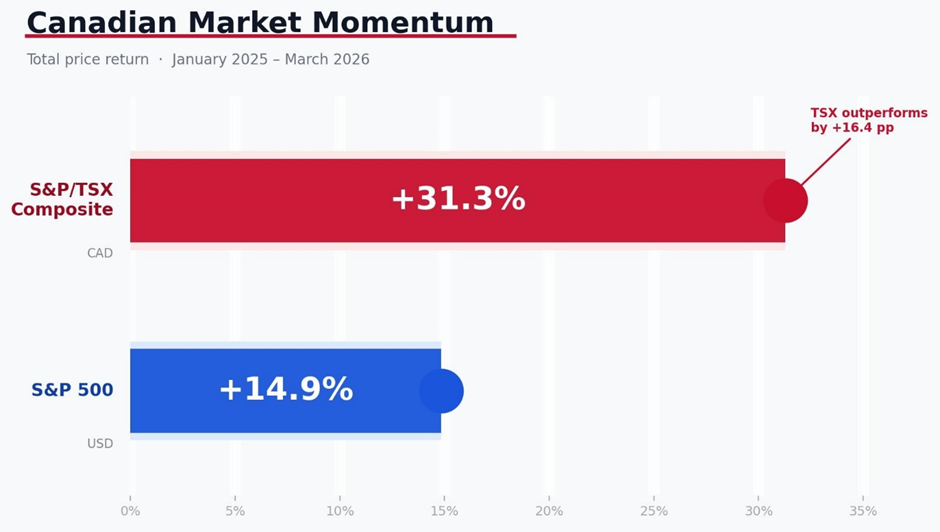
Source: Standard & Poor’s/multpl.com; Yahoo Finance, S&P Global; Trading Economics.
Big Six Banks | Canada’s profit machines
Canada’s big six banks – Royal Bank of Canada, Toronto-Dominion Bank, Bank of Montreal, Scotiabank, Canadian Imperial Bank of Commerce, and National Bank of Canada – are recognized globally for their stability, diversified revenue streams, and strong balance sheets. Royal Bank and TD Bank both possess total assets north of $2 trillion.
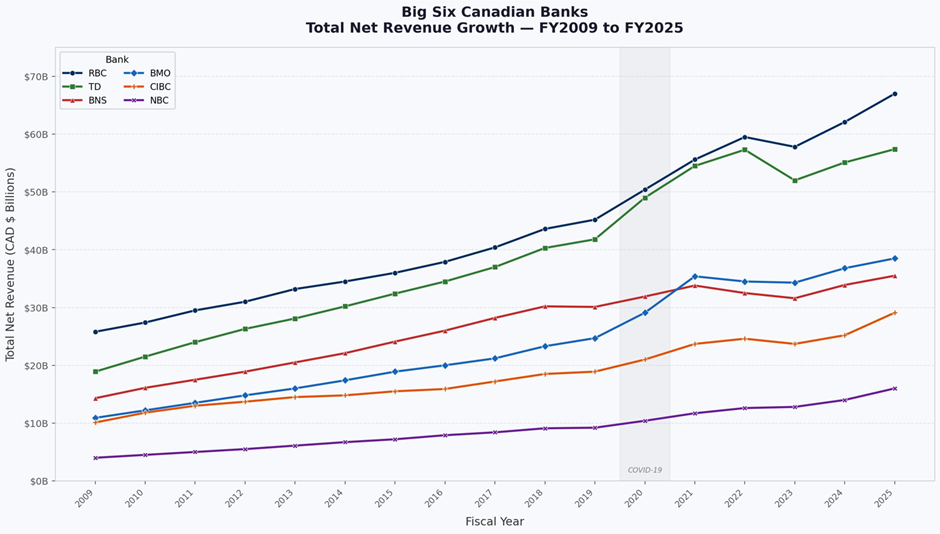
Source: Company annual reports & investor relations. Total net revenue = net interest income + non-interest income, in CAD billions. FY ends Oct 31. FY2025 figures based on latest available full-year reporting.
The big six banks have historically delivered strong growth in key areas. Crucially, Canada’s largest financial institutions have seen earnings growth improve due to rising interest income. Rising inflation in the post-COVID era spurred interest rate hikes, which have bolstered the bottom line for Canada’s largest financial institutions. This, in turn, has provided a boost to Canadian bank equities.
Historical Canadian Bank Return | Cumulative Growth $100 Invested
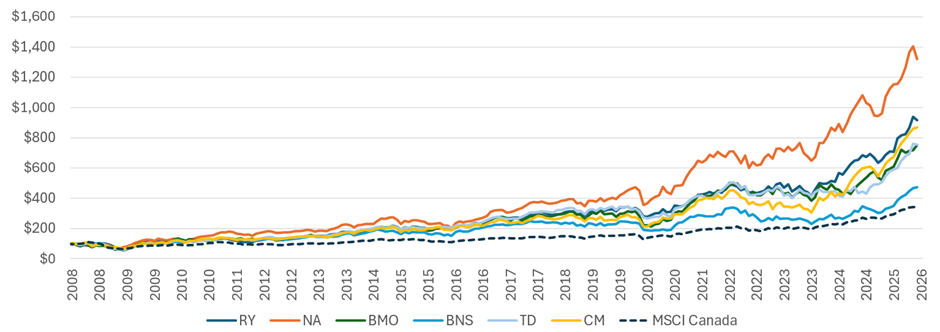
Sources: Harvest, as at February 27, 2026.
In January 2026, Harvest ETFs launched the Harvest Premium Yield Canadian Bank ETF (TSX: HPYB). This ETF is built to deliver twice monthly cash distributions. HPYB is an equal-weight portfolio of the Big Six Canadian banks. It employs actively managed puts & call option strategy that’s designed to generate income twice, every month. This innovative Harvest option strategy uses an option-wheel strategy involving written calls and puts that allows it to generate income, lower the portfolio’s volatility, and enhanced exposure to underlying securities.
Energy, Utilities, & Telecom | Wide moats and consistent income
Canada remains one of the world’s largest energy producers, with a significant oil and gas sector supported by exports and rising global demand. Its energy space generates revenue through gasoline and petroleum bulk stations, gas and petroleum wholesaling, as well as oil drilling and gas extraction. These industries, which generate hundreds of billions in annual revenue combined, are home to companies that generate consistent cashflow and dividend growth.
The country is also home to top names in the utilities space. Utility stocks are targeted for their stability in the face of economic turbulence. These businesses provide essential services like electricity, natural gas, and water. People and businesses need to use these services every day, regardless of the economic conditions. Moreover, utilities are heavily regulated, which means revenues and returns are overseen by government bodies, ensuring a high degree of predictability.
That is also true in the Canadian telecommunications space. While they may not boast the robustness of some of the top players in energy and utilities, the biggest names in telecom also operate in an oligopoly. Building a cellular infrastructure that can cover Canada is an incredible difficult and costly enterprise. Competitors to Canadian telecoms, like Freedom Mobile, still suffer from spotty coverage due to their lack of reach.
Top Canadian companies in this spaces that boast long histories of dividend growth can be found in the Harvest Canadian Equity Income Leaders ETF (TSX: HLIF). This ETF aims to capture the powerful traits of Canada’s leading companies, combining them with an active covered call option writing strategy to generate steady monthly income.
Dividend kings are equities that have delivered at least 50 consecutive years of dividend growth. The true cream of the crop of dividend payers. Canadian Utilities Ltd has delivered 53 straight years of dividend growth, while Fortis has delivered 51 consecutive years. Both can be found within HLIF. It also boasts names like Canadian Natural Resources – 24 straight years of dividend growth, BCE – which currently boasts a 4.9% dividend yield, and players in consumer discretionary like Magna International and Restaurant Brands.
Annualized Performance
As at February 28, 2026
| Ticker | 1M | 3M | 6M | YTD | 1Y | 2Y | 3Y | SI |
|---|---|---|---|---|---|---|---|---|
| HLIF | 6.40 | 9.17 | 20.18 | 8.56 | 33.92 | 25.74 | 17.49 | 12.85 |
Canadian success stories | Shopify, gold rush, and more
The growth of OpenAI, Anthropic, and other artificial intelligence companies in the United States has soaked up considerable attention. Canada is also home to some exciting stories in this space. There is Cohere in Toronto, a leading developer of large language models (LLMs), BenchSci, which uses machine learning in drug discovery, Tenstorrent, an AI hardware company designing computers for AI, and WealthSimple, a fintech company that is using AI for wealth management.
Accessing Shopify with high monthly income | SHPE
Shopify, a multinational e-commerce company that offers platforms for retail point-of-sale systems, has emerged as one of Canada’s biggest technology success stories on the back of these trends.
A legacy of the COVID-19 pandemic is dramatic acceleration in online shopping. Indeed, sales tied to e-commerce posted growth of 50% during the pandemic, totalling US$870 billion. In 2025, annual e-commerce sales in the U.S. exceeded US$1.5 trillion for the first time. While some consumers have returned to in-store shopping many more have continued to shop online.
Shopify projects strong continued growth in its 2026 outlook, with revenue to increase by more than 30% and gross profit to rise by over 25%. Some of the key drivers for Shopify include its AI integration, which includes its embedded AI like Sidekick. Moreover, the company is moving aggressively into emerging markets and B2B segments.
Source: Bloomberg As at February 28, 2026
The Harvest Shopify Enhanced High Income Shares ETF (TSX: SHPE) invests all its assets in shares of Shopify. It overlays an active covered call writing strategy on up to 50% of the portfolio and applies modest leverage at around 25% the aim to generate high levels of monthly income.
A top gold stock and a high income Canadian portfolio
In late 2025, we highlighted the incredible surge for gold. The price of gold reached over US$5,000 per ounce on Monday, January 26, 2026. It has been bolstered by geopolitical turmoil in Europe and the Middle East, as well as the ongoing trade war. Monetary policy has also served to boost gold, as central banks have reduced rates while central banks have also purchased more physical gold. Central banks around the world now hold more gold than US Treasuries for the first time in 30 years.
Silver has also had a phenomenal run. It has climbed from roughly US$50 per ounce in March 2025 to nearly US$115 per ounce at the time of this writing. While silver has been the beneficiary of some of these developments, including demand for a safe-haven, it has also been propelled due to rising industrial demand. This is due to record usage in solar panel manufacturing, electric vehicles, AI data centres, and advanced electronics.
Canada remains one of the largest producers of gold and silver ore on the planet. The chart below illustrates the rise in gold and silver ore production value since the beginning of this decade.
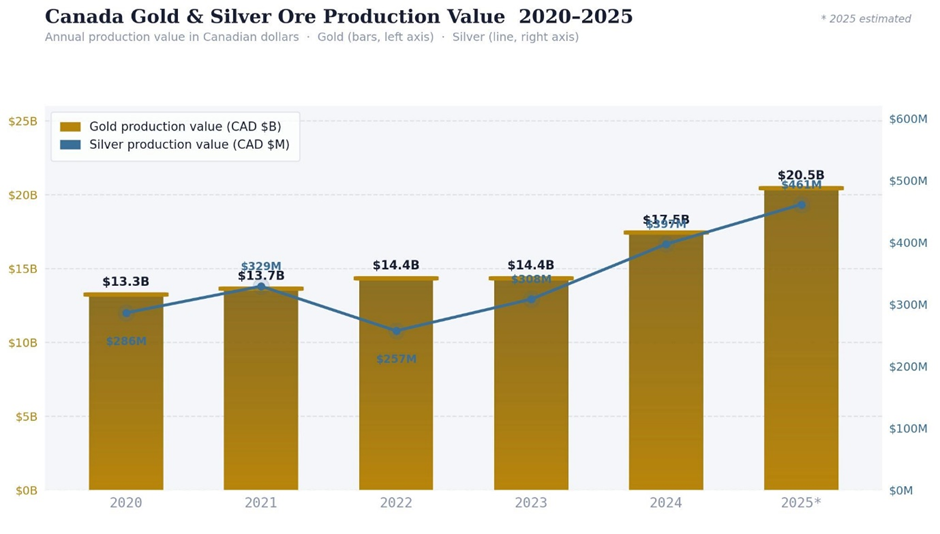
Sources: Natural Resources Canada (NRCan) Annual Mineral Production Statistics. Statistics Canada Table 16-10-0022. EY Canada Gold Mining Report 2025 – USGS via CIEC Data – Bank of Canada annual average CAD/USD rates – IBISWorld (2025 est.) *2025 Estimated
Silver valued calculated: USGS mine volume x annual avg USD/oz price x CAD/USD rate. All values in current Canadian dollars. Chart compiled March 2026.
The Harvest Agnico Eagle Enhanced High Income Shares ETF (TSX: AEME) offers access to Agnico Eagle, a gold producer with operations in northern Canada, Quebec, Mexico, and Finland. It overlays a covered call strategy and modest leverage with the aim to generate high monthly distributions.
For access to Shopify, Agnico Eagle, and other top Canadian stocks like TD Bank, Enbridge, and more, there is the Harvest Canadian High Income Shares ETF (TSX: HHIC). HHIC offers a multi-sector portfolio that holds TSX-listed equities. It is designed to combine the benefits of income generation with exposure to Canada’s strongest businesses across various sectors.
Disclaimer
This communication should not be considered as advice and/or a recommendation to purchase or sell the mentioned securities or used to engage in personal investment strategies. Tax, investment and all other decisions should be made with guidance from a qualified professional.
Commissions, management fees and expenses all may be associated with investing in Harvest Exchange Traded Funds managed by Harvest Portfolios Group Inc. (the “Funds”). Please read the relevant prospectus before investing. The Funds are not guaranteed, their values change frequently, and past performance may not be repeated. Distributions are paid to you in cash unless you request, pursuant to your participation in a distribution reinvestment plan, that they be reinvested into available Class units of the Fund you own. If a Fund earns less than the amounts distributed, the difference is a return of capital.
Certain statements included in this communication constitute forward-looking statements (“FLS”), including, but not limited to, those identified by the expressions “expect”, “intend”, “will” and similar expressions to the extent they relate to the Fund. The FLS are not historical facts but reflect Harvest’s, the Manager of the Fund, current expectations regarding future results or events. These FLS statements are subject to a number of risks and uncertainties that could cause actual results or events to differ materially from current expectations. Although Harvest, the Manager of the Fund, believes that the assumptions inherent in the FLS are reasonable, FLS are not guarantees of future performance and, accordingly, readers are cautioned not to place undue reliance on such statements due to the inherent uncertainty therein. Harvest, the Manager of the Fund, undertakes no obligation to update publicly or otherwise revise any FLS or information whether as a result of new information, future events or other such factors which affect this information, except as required by law.